
Start with a normal baseline, define the application and filter boundary, select one condition such as Lag or Drop, repeat one known action, record visible and server-side evidence, then select Stop and repeat the baseline. Use a focused scenario page when the question is specifically latency, loss, bandwidth, jitter or packet order.
01
What Windows network testing should answer
A useful test has a product question, a narrow traffic boundary and a result that another person can reproduce.
Windows network testing is not the same as clicking a speed-test button or declaring that a connection feels slow. A Windows network testing plan asks what a real application should do when a known condition changes. For example: when a staging API receives an added 250 ms delay, the order page should acknowledge the click, preserve its filters, show progress and render one result without sending a duplicate request. That sentence gives the operator an action, a condition, a visible expectation and a way to inspect side effects.
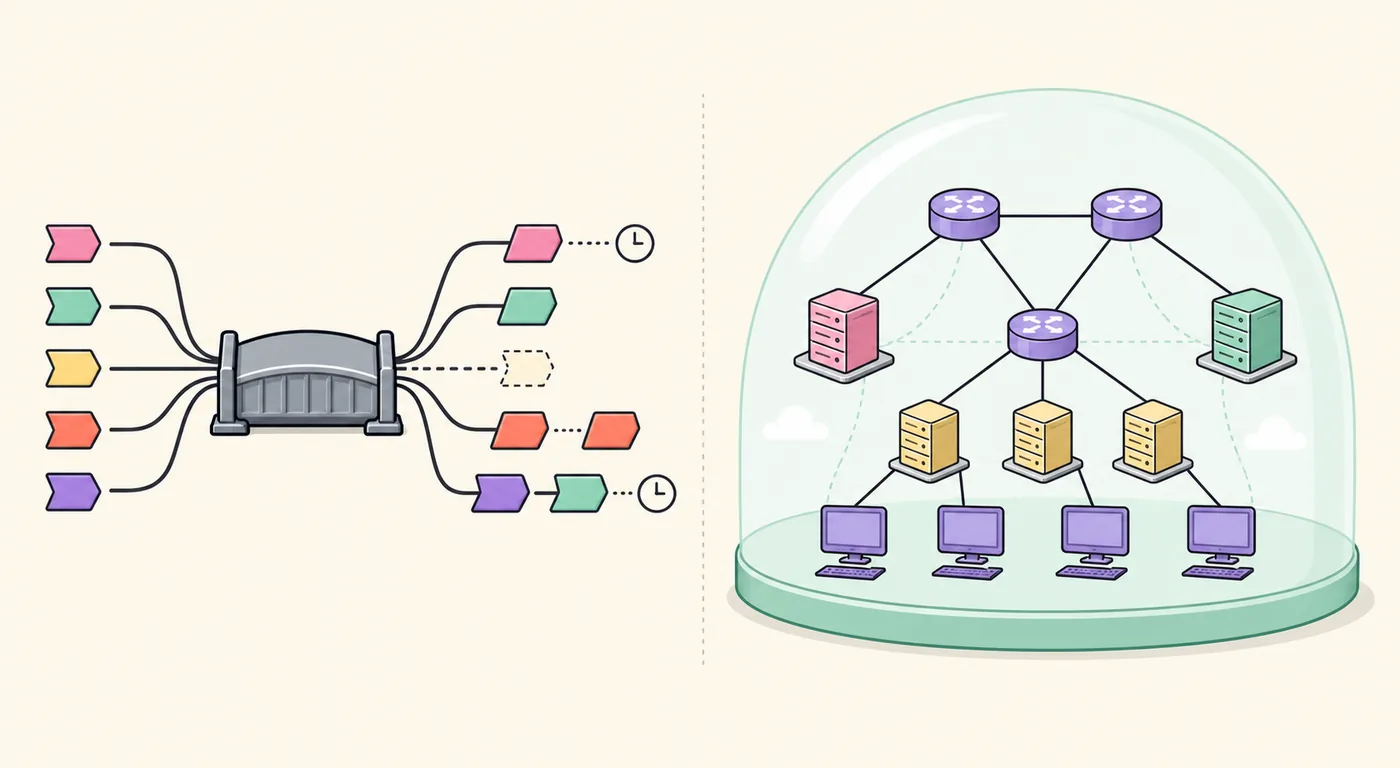
Clumsy changes matching Windows traffic through WinDivert. Its Lag, Drop, Duplicate, Out of order, Tamper and Throttle modules let you observe an application under a repeatable impairment. It is a condition generator, not a virtual router, an ISP diagnosis tool or proof that a mobile network behaves the same way. The distinction matters: a controlled packet condition can reveal a client state or retry bug, but it cannot explain every cause of a production outage.
This overview complements the network testing tools comparison and the network emulator guide. Those pages answer which tool fits or how emulation differs from simulation. This page answers how to plan a Windows network testing session and choose the next focused recipe. Use only a device, application and network path that you own or are explicitly authorized to test.
- One owned or authorized application workflow.
- One condition and one recorded value per run.
- A baseline captured before and after the impairment.
- Client, server and user-visible evidence when a request has side effects.
- A written stop and recovery condition.
02
Choose a test condition and evidence
Choose the smallest condition that can answer the question. Combining Lag, Drop and Throttle in the first run makes a failure difficult to explain because several mechanisms changed at once. Start with a modest value on a non-critical workflow, then create a separate boundary run if the requirement needs a harsher condition. Keep the name of the condition, direction and value in the test record rather than relying on memory.
The right evidence depends on the behavior under test. This Windows network testing matrix keeps the question visible. A delayed page needs timestamps, loading and timeout states. A loss test needs request identifiers, retry counts, reconnect events and server records because a dropped response does not prove that the original operation failed. A throughput test needs transfer size, progress, cancellation and final integrity. A packet-order test needs sequence numbers, buffering and reassembly evidence.
Use the focused guides after the matrix is clear: latency testing covers fixed delay and timeout behavior, packet loss testing covers Drop and retries, bandwidth throttling covers constrained transfers, and out-of-order testing covers sequencing. The jitter guide explains why Clumsy does not provide a native random-jitter control.
| Question | Start with | Evidence to collect |
|---|---|---|
| Does the interface explain a slow response? | Lag with 200-300 ms on one target | Acknowledgement, loading state, timeout and cancellation |
| Do retries recover from missing traffic? | Drop at a low chance | Request IDs, retry count, reconnect and duplicate-side-effect checks |
| Does a transfer remain usable? | Throttle on one representative transfer | Progress, queue behavior, cancellation and final byte count |
| Can the client handle repeated delivery? | Duplicate on a safe test record | Idempotency result and server record count |
| Does a stream preserve sequence? | Out of order on a disposable stream | Sequence numbers, buffering, reassembly and recovery logs |
03
Build a baseline before changing packets
A controlled run starts with normal behavior that can be compared later.
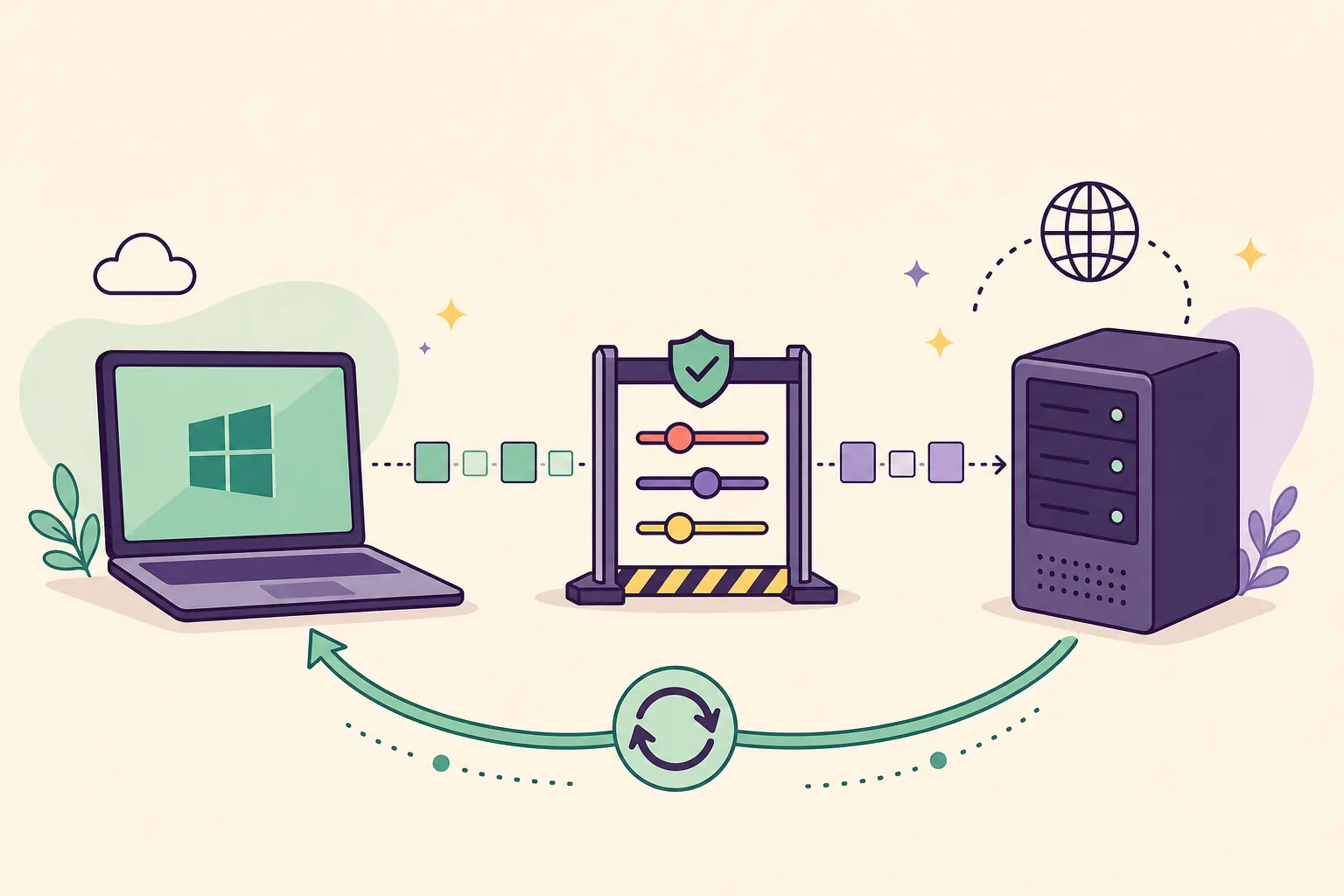
Before opening Clumsy, confirm whether the problem is an actual connectivity fault or a behavior you want to reproduce. Microsoft's Test-NetConnection documentation describes ICMP, TCP port, route and route-selection diagnostics. A baseline can include the local gateway, DNS resolution, the target host and the application action. These checks do not replace product testing; they stop a pre-existing outage from being misread as an effect of Clumsy.
Run the exact workflow without impairment. In Windows network testing, record the application build, Windows version, target host or port, approximate response time, loading behavior, status code, request identifier, server log entry and transfer size. Pause unrelated downloads and use staging data or a disposable account for writes. If the baseline is already inconsistent, stop and fix the environment before applying a packet condition.
Verify the archive and keep its provenance with the test record. The official jagt/clumsy 0.3 release is a portable Windows ZIP with Win64 and Win32 choices plus A/B/C signature variants. The official manual documents filters and direction. Do not replace a blocked archive with an unknown modified build.
- DefineWrite one product question, target, condition and pass statement.
- DiagnoseCheck the gateway, DNS, route and target before simulating a known condition.
- BaselineRun the exact application action normally and save the evidence to compare.
- ProtectUse staging data, a disposable account and a safe recovery path for side effects.
04
Protect the test scope with a narrow filter
The filter is the blast-radius boundary. A rule that matches every packet can affect authentication, monitoring, remote support, updates, calls and unrelated browser tabs. Start with a known destination, protocol or port that represents the application. A port expression can still include multiple applications, so document what it matches instead of calling it application-specific by default.
Direction changes the observation. Outbound delay tests the request path, while inbound delay tests loading and timeout feedback. Start with one direction and create a second run only when both paths matter. If the filter cannot be explained in one sentence, do not paste it from a forum or video. Select Stop, simplify the expression and save the filter, direction and timestamps with the result.
System-wide testing belongs on a disposable or explicitly approved machine. For Windows network testing, keep remote access outside the impairment scope so a broad filter cannot strand the operator. For a shared workstation, prefer one known target over an all-traffic rule. Scope is not paperwork: it is what makes a failed request attributable to the condition and what lets the team recover without guessing which process was affected.
| Scope choice | Useful when | Common mistake |
|---|---|---|
| Known host or service | One staging endpoint is the target | Assuming the host covers every dependency |
| Protocol and port | The workflow has a clear transport boundary | Impairing other applications that share the port |
| Inbound only | Response timing or render behavior is the question | Forgetting that the request path stays normal |
| Outbound only | Request delay or send-side behavior is the question | Treating added delay as total round-trip latency |
| All traffic | A disposable, explicitly approved system-wide test | Running it on a work machine or shared connection |
05
Run one Clumsy condition and record results
A good test produces a comparison, not just a slow screen.
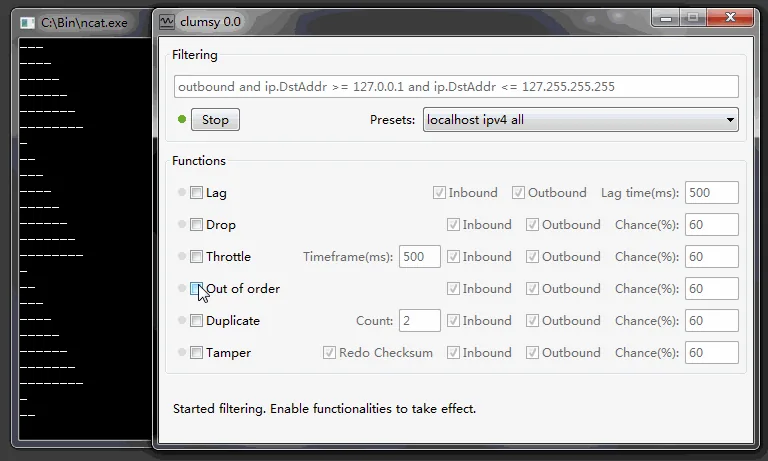
Enable one module and enter one documented value. Lag is often the clearest first condition because it delays matching packets without intentionally discarding them. A 200-300 ms delay is a practical starting point for a non-critical workflow; increase it only when a product requirement asks for a boundary. Select Start, perform the same action used for the baseline and avoid changing the value during the run.
Observe the first visible acknowledgement and the final response. Does a button show progress? Can the user cancel? Does the client preserve form state? Which timer fires first? Pair screen observations with request IDs, timestamps, status codes and server logs when the operation can be retried or repeated. A missing response does not prove that the server never completed the original request.
Keep each run short and named. Save the application and Windows versions, Clumsy version, archive source, filter, direction, module values, baseline, observed result and recovery confirmation. This Windows network testing record turns a temporary impairment into a reproducible QA finding. It also makes it clear whether a failure belongs to the client, server, transport condition or test setup.
- ConfirmReview the filter, direction and module list immediately before Start.
- RunPerform one known action with one condition and one recorded value.
- ObserveCapture user feedback, client timing and server-side evidence.
- StopSelect Stop before changing a value or moving to a new scenario.
- CompareRepeat the baseline action and record whether normal behavior returned.
06
Turn the result into a focused test recipe
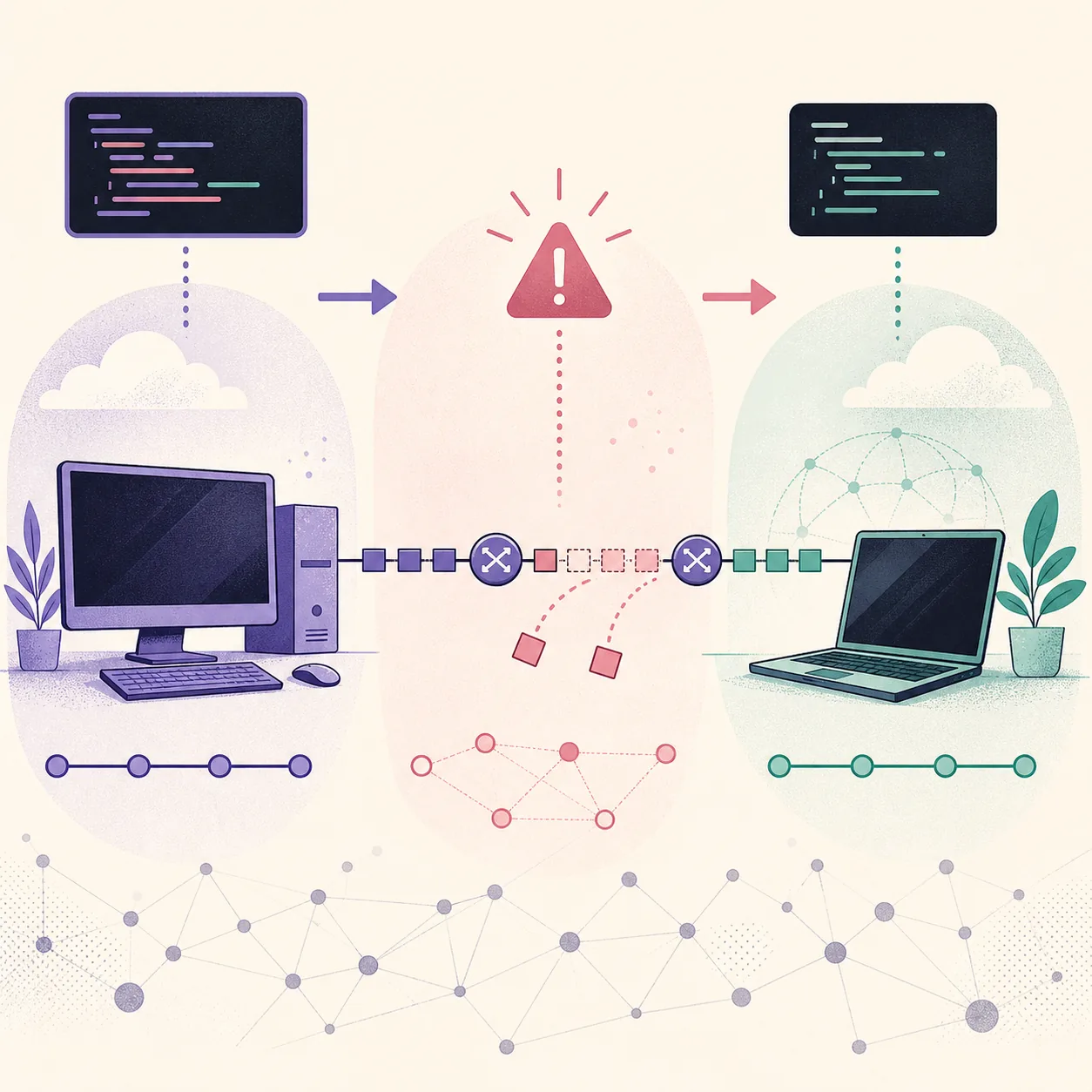
Once the question is clear, move from the hub to the smallest recipe that matches it. A latency recipe should define delay, direction, timers and the recovery check. A packet-loss recipe should define the Drop scope, retry expectation and server-side idempotency evidence. A bandwidth recipe should define the transfer, progress signal and final integrity. A packet-order recipe should define sequence evidence and buffering behavior.
Do not use a focused page to widen the test. Keep the filter and one condition stable while you learn what the application does. If the scenario needs two conditions, run them separately first and explain why the combined boundary is useful. If the real issue is a driver or startup failure, use Error Code 3 troubleshooting instead of treating a broken filter as a network result.
The next page should make a single assertion easier to reproduce. A Windows network testing hub should send the reader to the smallest useful recipe. Link back to this overview when a reader needs the matrix or evidence checklist, and link to the complete Clumsy setup guide when the operator has not yet configured a filter. This keeps the category page broad while each child page stays specific.
| Need | Next page | Keep separate |
|---|---|---|
| Understand the first run | How to Use Clumsy | Do not widen the filter just to get a stronger effect |
| Test fixed delay | Latency simulator | Do not call delay a bandwidth limit |
| Test missing packets | Packet loss simulator | Do not infer server failure from a lost response |
| Test a slow transfer | Bandwidth throttling | Do not combine several rates in one run |
| Test ordering | Out-of-order packets | Do not mix Drop before confirming sequence behavior |
07
Recover, document limits and use Clumsy safely
Recovery is part of Windows network testing, not a cleanup detail. Select Stop as soon as the observation is complete, close Clumsy when appropriate and repeat the original baseline action. Confirm that the target workflow and one unrelated ordinary action behave normally. If the network remains unstable, check whether Clumsy is still running, whether another packet tool or VPN is active and whether the filter was broader than expected. Stop experimenting while the baseline is unknown.
Clumsy is not a complete network laboratory. Choose a virtual simulator for router topologies, a proxy for HTTP-specific rewriting, browser throttling for one tab, Linux traffic control for a Linux host or a programmable controller for automated cross-platform profiles. Real mobile behavior also changes with radio quality, congestion, handoffs, DNS, routing and server load; a local impairment is one repeatable Windows network testing input, not a promise about every carrier.
Use the tool only on owned systems or with explicit permission. Do not use network impairment to disrupt third-party services, conceal cheating or interfere with another user. Keep a record of the release archive, checksum, Windows version, application build, filter, direction, condition, observed evidence and recovery confirmation. The official Clumsy 0.3 release page keeps version facts separate from the QA result.
A run is complete only when the condition is stopped, the process state is understood and the same baseline action succeeds again. Clumsy creates the condition; it does not prove the product is correct by itself.
FAQ
Windows network testing FAQ
What is the best first Windows network testing scenario?
Use one non-critical application, a narrow filter, a modest Lag value such as 200-300 ms and one repeatable action. Record the normal behavior first, observe one known change and prove recovery after Stop.
Should I diagnose a connection before simulating packet loss?
Yes. In a Windows network testing workflow, check the local gateway, DNS, route and target with normal diagnostic tools first. Use Clumsy afterward to reproduce a controlled loss condition for an authorized application test; do not use a simulated failure as proof of an ISP fault.
Can Clumsy test latency, packet loss and bandwidth?
Yes. Windows network testing with Clumsy can use Lag for delay, Drop for loss and Throttle for transfer behavior. Duplicate and Out of order cover additional delivery conditions. Test one condition at a time before combining any boundary profile.
Why does the filter need to be narrow?
A narrow filter limits the blast radius and makes the result easier to attribute and recover. A broad rule can affect remote access, updates, calls and unrelated applications on the same Windows machine.
What is the current official Clumsy version?
The official jagt/clumsy latest release API checked on November 15, 2026 still resolves to version 0.3, published on October 21, 2023. Use the official release history rather than trusting a higher number on a mirror.
Is Windows network testing with Clumsy a replacement for production monitoring?
No. It is a controlled reproduction method. Production monitoring, logs, traces and real network diagnostics are still needed to identify an outage or measure a live service.